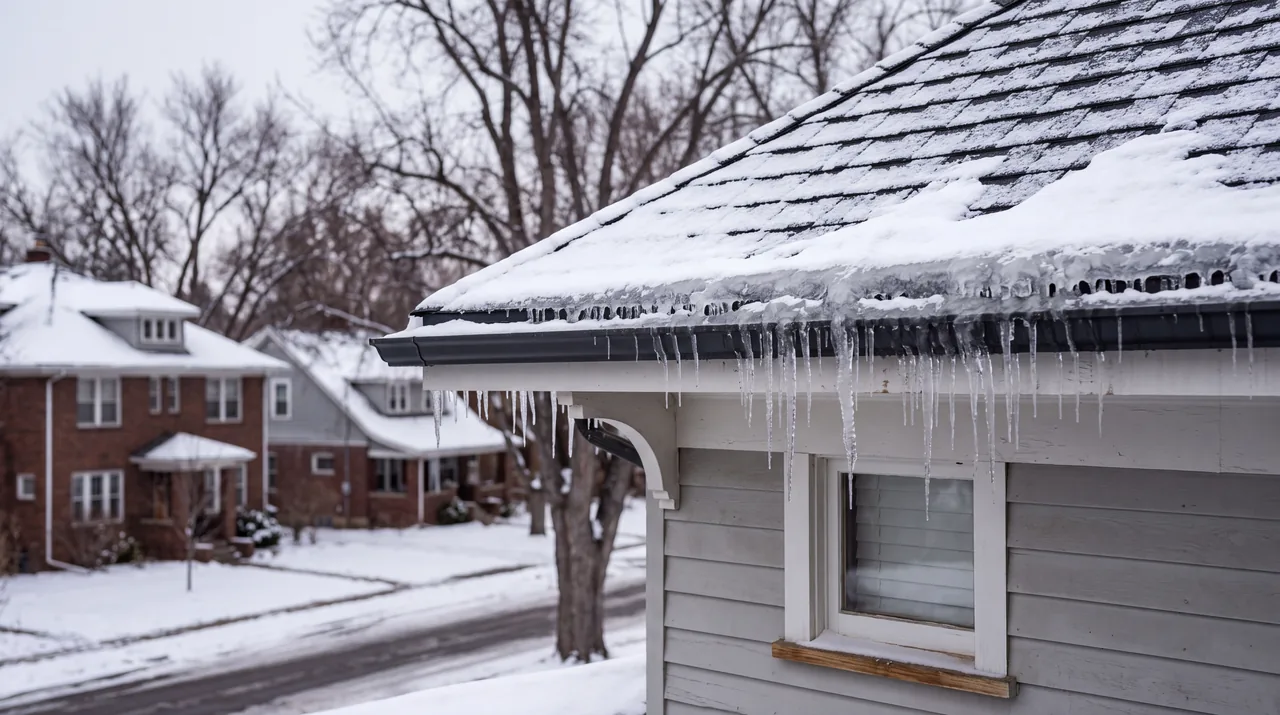
Ice dams form when heat from the house melts snow on the upper roof, the water runs down to the cold overhang at the eave, and it freezes there into a ridge that holds back the next round of meltwater. That trapped water backs up under the shingles, and shingles are made to shed water running downhill, not to sit in a puddle. The first hard freezes and early snow reach the Front Range in October and November, so now is the time to find out whether your house sets up the problem.
The cause is almost never the shingles. It's the attic. Below is what happens on the roof, in the attic and at the eave, then a list of fixes ordered from cheapest to most involved.
What happens on the roof
Snow insulates. A blanket of it traps whatever heat comes up through the roof deck, so if the deck over a heated room sits above freezing, the bottom of the snow melts even on a cold day.
That water runs down under the snow to the overhang. The overhang sits outside the wall line, over no heated space, so it stays about as cold as the outside air, and the water freezes there. Each melt adds to the ridge. The icicles are only the visible part.
Front Range weather gives the cycle plenty of chances to run: bright sun after a snowfall, then a hard freeze at night, over and over.
What happens in the attic
A warm attic drives the whole thing. Two things warm it: heated air leaking up through gaps in the ceiling, and heat moving through insulation that's too thin. Air leaks usually do more of the damage, and they hide in predictable places:
- The attic hatch or pull-down stair, often with no weatherstrip and no insulation on its back.
- Holes through the top plates of walls for wiring and plumbing vents.
- Open chases around chimneys, flues and duct runs.
- Recessed lights that aren't rated airtight and for contact with insulation.
- Bathroom and kitchen fans that dump moist air into the attic instead of outside.
Attic ventilation is the other half. Air drawn in at the soffits and let out near the ridge carries off heat that gets through and keeps the roof deck closer to the outdoor temperature. It only works when the intake is open, and insulation packed against the soffit vents can stop it entirely. No amount of ventilation keeps up with a ceiling that leaks heated air like a chimney, which is why air sealing comes first.
What happens at the eave and in the walls
Water held behind the ice works its way under shingle laps and around nails until it reaches the roof deck. From there it follows the framing down into the top of the exterior wall. An ice dam roof leak usually shows up as a stain or peeling paint on the ceiling near an outside wall, damp drywall at the top of a wall, or water around the head of a window.
Some damage stays out of sight. Wet insulation stops insulating well, and wet framing inside a closed wall can grow mold.
Gutters get blamed, but they don't cause ice dams. A clogged gutter gives the ice a head start, yet a house with no gutters still gets ice dams if the attic runs warm.
The eave is where roof, wall, attic and gutter all meet, and small gaps in that joint are what winter finds. It's one of the construction details where Colorado houses leak or last, and it deserves the same attention as anything you can see from the street.
How to prevent ice dams, cheapest fix first
Work down this list. The early items manage the symptom. The later ones remove the cause.
- Rake the lower edge of the roof after a heavy snow, with a long-handled roof rake used from the ground. Don't climb onto a snowy roof, and don't chip at ice with a hammer or shovel. That breaks shingles faster than the water does.
- Clean gutters and downspouts in the fall so meltwater has somewhere to go.
- Use heat cables as a stopgap. Cables zigzagged along the eave and run through gutters melt channels so water can drain. They draw power, they don't touch the cause, and a dam above the cable still backs water up. Follow the manufacturer's installation instructions, including its requirements for the outlet and circuit.
- Air seal the attic floor. Seal the gaps listed above, using fire-rated materials around flues and chimneys as code requires. Weatherstrip and insulate the hatch, and vent bath and kitchen fans outside. For most houses this is the step that does the most.
- Add insulation once the air sealing is done. The U.S. Department of Energy publishes recommended attic insulation levels by climate zone, and the International Residential Code, as adopted by your local building department, sets the minimum. Install baffles at the eaves so new insulation can't block the soffit vents.
- Correct the attic ventilation. Open or add soffit intake, then match it with exhaust at or near the ridge. Shingle manufacturers generally advise against mixing exhaust types, such as a ridge vent with a powered fan, on one attic.
- Install ice and water shield membrane at the eaves when the roof is replaced. This self-adhering sheet goes on the deck under the shingles, from the edge up past the line of the exterior wall, and seals around the nails driven through it. It doesn't stop the dam. It keeps the water behind it out of the house. Codes commonly require an ice barrier like this in cold climates; your local building department decides whether your house needs it and how far up it runs. We'd also run it in valleys and around chimneys and skylights.
- Rebuild the problem sections. Vaulted ceilings with shallow rafters and roofs crowded with valleys and dormers can leave no room for enough insulation and airflow. Fixing them means opening the roof or ceiling and changing the assembly, often by adding insulation above the deck. That's design work, best done once, during a reroof or renovation.
When the fix involves the roof
If your roof is near the end of its life, the reroof is the best time to solve ice dams for good. The deck is open, the membrane can go in, and the ventilation path can be corrected at the soffits and ridge in the same pass. We'd plan the eave as one assembly: membrane, drip edge, gutter and the airflow behind them, as part of our roofing, siding and window work.
If last winter already left stains, repairs to water-damaged ceilings, walls and trim should come after the attic is sealed and insulated, so the patch is the last one you need.